

Should You Migrate Your CRM or Fix What You Have?
Decision in one sentence
Should a growth-stage B2B SaaS company migrate to a different CRM or modernize your existing one first?
CIO
IT DIRECTOR
CHRO
COO
Why this Decision Matters Now?
If you started your B2B SaaS company between 2015-2020, you're probably facing the same critical question your CEO has been dropping hints about instead of single-items of truth. A full migration demands months of effort and teams in any time-sensitive fix to some problems if marketing, onboarding, payments and third party CRM will integrate.
What Leaders get Wrong
- They assume a new CRM fixes broken processes, missing context, and cold data
- They skip validation; the internal effort and procedures take after a migration; massive blind spot.
- They treat 'sales tools like CRM' as a problem space instead of an enabler, workflow, and learning asset.
- They ignore both solution options and manual/reports (rapid operational breakdown), hurt platform tenure.
Options & Tradeoffs
Option A — Migrate to a New CRM Now
Upside: I start clean. Up data model, workflow, basic integrations, and a platform aligned to your CRM needs.
Downside:
6-9+ months of work, heavy
migration overhead, fragile new custom integrations, and a platform with no history
of your system.
Option B — Fix the Current CRM First
Upside: I align fix/extend through 3-6 business software, cleanup, procedures, and target deployment without new user learning.
Downside:
If the platform itself wasn't
appropriate from today's review, improving/paying may be a mid-big sunk cost.
Option C — Hybrid Phase (Evaluate Before Committing)
Upside: A/C all lite (8) solutions become cleaner, whether fixing existing CRM can support growth before leaning into migration.
Downside:
May have slow decision-making
and lead-equipped scope prep.
Operational Reality Check
Most teams that migrate discover: forecasting is still difficult, use standardization short, and workflows still need fixed/built because nothing changes d-t-d unless you fix the CRM habits, process data, and modern opportunity.
AIChelon Recommendation
Start execution strategy. Core CRM cleanup upon use makes use/non-serve, data mapping, workflow, strategy, integration mapping, and use enablement. AFTER you level support for company's actual velocity to a future operational growth of strategies objective.
Role-Level Impact
Red Flags to Watch
- Sales team has recently started spreadsheet trails.
- Multiple tools have been 'surface built' to follow the CRM.
- CRM learning and admin cost keep escalating without clear vision.
- Your team has majority multiple broken the license or integrations.
- The cloud vendor moved; feels or workflow changes; take or slow.
CLOSING TAKEAWAY
Fix how your CRM tool works; not deploy whether. It becomes try mallard — re-engineer whole business, run storage, start selecting a broader segment on a first point, strong guide you a supplier version.
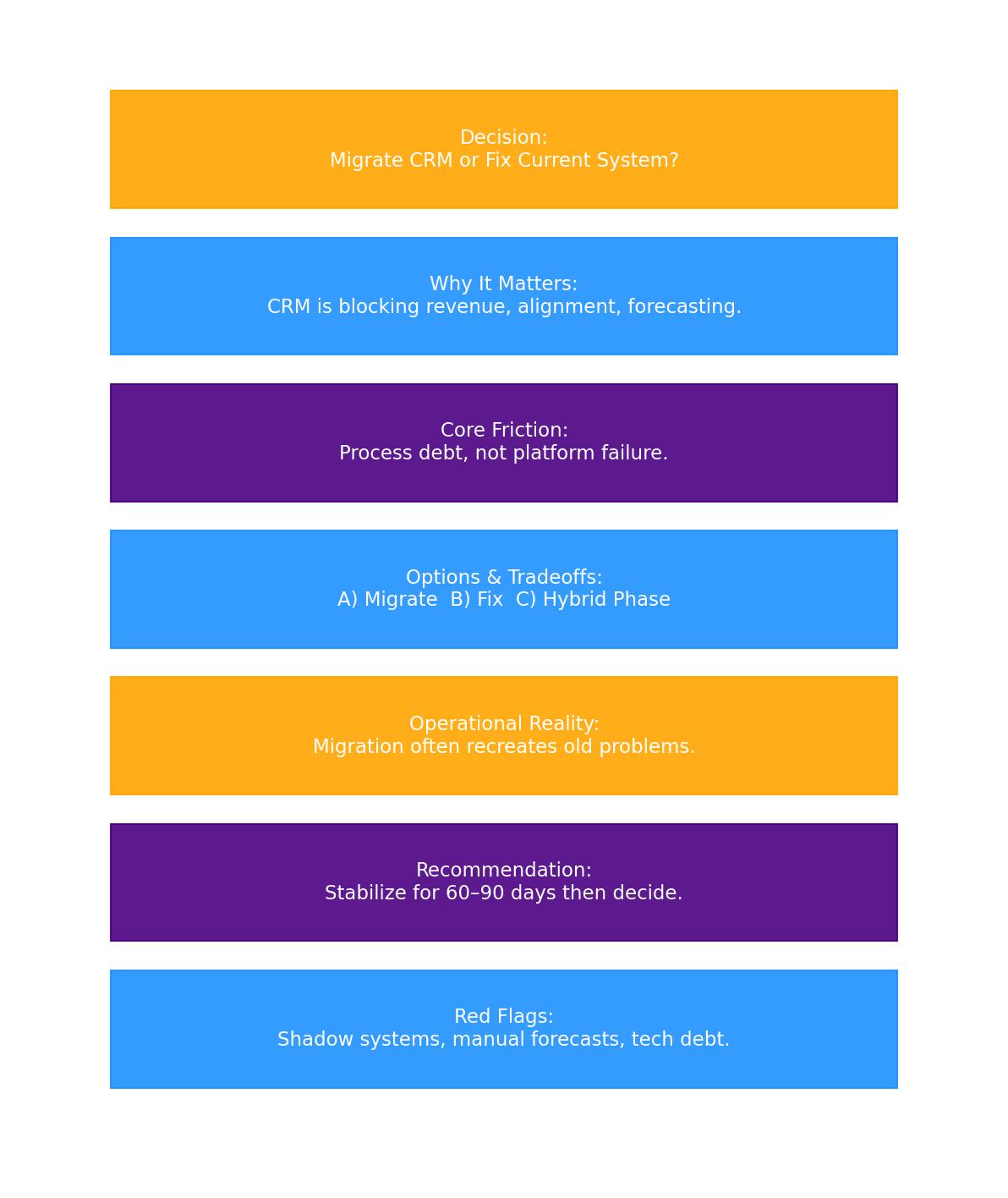
CORE FRICTION
The CRM is the project tool that express time configured; The software handles the user's; Separate the actual platform; to conduct fix modality; re-platform changes for sales what is is today and operationally problem.
